INTRODUCTION
Educational Technology refers to the systematic use of modern tools, methods, and scientific principles to enhance teaching and learning. It involves the design, development, application, and evaluation of instructional processes and resources to improve educational effectiveness. Educational technology supports teachers in delivering lessons efficiently and helps learners achieve better understanding through interactive, innovative, and learner-centered approaches.

Educational Technology (EdTech) is the systematic application of scientific knowledge, tools, methods, and resources to improve teaching, learning, and educational management.
It involves the design, development, use, and evaluation of learning processes and instructional resources to make education more effective, efficient, and engaging.
Educational technology is not only machines or computers; it also includes teaching methods, instructional models, media, and strategies that enhance learning outcomes.
⸻
2. Scope of Educational Technology
Educational technology covers:
• Teaching–learning processes
• Instructional design (ADDIE, ASSURE, etc.)
• Learning resources (audio, visual, digital)
• Assessment and evaluation tools
• Educational communication
• Educational management and administration
⸻
3. Applications of Educational Technology in Teaching
Educational technology is applied in teaching through:
a. Instructional Design
• Planning lessons using models like ADDIE and ASSURE
• Organizing objectives, content, methods, and evaluation
b. Teaching Aids and Media
• Charts, posters, radio, television
• Projectors, computers, smart boards
• Mobile phones and educational apps
c. E-Learning and Online Education
• Virtual classrooms
• Learning Management Systems (LMS)
• Online courses and digital libraries
d. Assessment and Evaluation
• Online quizzes and tests
• Computer-based assessments
• Immediate feedback and performance tracking
e. Individualized and Self-paced Learning
• Learners progress at their own speed
• Supports diverse learning needs

4. Importance of Educational Technology
Educational technology is important because it:
1. Enhances quality of teaching and learning
2. Makes learning more interesting and interactive
3. Promotes student-centered learning
4. Improves retention and understanding
5. Supports inclusive education
6. Saves time and instructional effort
7. Expands access to education beyond classrooms
5. Advantages of Educational Technology
For Teachers:
• Simplifies lesson preparation
• Improves teaching effectiveness
• Helps manage large classes
• Provides diverse teaching strategies
For Learners:
• Encourages active participation
• Supports visual and auditory learning
• Enables independent learning
• Improves academic performance
For Educational Institutions:
• Efficient administration
• Better resource management
• Cost-effective delivery of education
• Global access to knowledge
⸻
6. Roles of Educational Technology in Education
Educational technology plays the following roles:
1. Facilitator of learning – supports teaching and learning processes
2. Motivator – increases learner interest and engagement
3. Instructional support – assists teachers in lesson delivery
4. Bridge to knowledge – connects learners to global information
5. Evaluation tool – supports assessment and feedback
6. Agent of innovation – introduces modern teaching methods
⸻
7. Historical Development of Educational Technology
📜 The Pre-Digital Foundations (Before ~1950s)
The story begins not with electricity, but with the human need to record and transmit knowledge.
· Early Tools (1700s-1800s): The hornbook (a wooden paddle with a paper lesson) and the slate were the first "personal learning devices," allowing for reusable practice. The blackboard/chalkboard (early 1800s) revolutionized classrooms by enabling a teacher to instruct many students at once with visual aids.
· The Print Revolution: The widespread availability of textbooks in the 19th century was perhaps the first major EdTech disruption, standardizing curriculum and enabling self-paced study.
· The Audiovisual Movement (Early 1900s): With inventions like film and radio, the "visual instruction" movement began. School museums (curating films and slides) popped up, and educational radio broadcasts brought lessons on air. This era established the principle that learning could be mediated through technology.
⚙️ The Birth of "Modern" EdTech (1950s-1980s)
This period saw technology become a systematic field of study, heavily influenced by behaviorist psychology (B.F. Skinner's teaching machines) and communication theory.
· Skinner's Teaching Machine (1954): A mechanical device that presented questions, required a constructed response, and provided immediate feedback. It laid the groundwork for programmed instruction and the concept of self-paced mastery learning.
· The Mainframe and PLATO (1960s): The PLATO system, developed at the University of Illinois, was a landmark. It was the first computer-based learning system, featuring forums, message boards, and even multiplayer games—foreshadowing online communities.
· The Rise of Personal Computers (Late 1970s-1980s): The arrival of Apple II and IBM PCs brought computing power into schools. Pioneering software like Logo (which taught programming concepts) and Oregon Trail (simulation-based learning) showed computers could be interactive and engaging tools for discovery.
🌐 The Digital Communication Revolution (1990s-2000s)
The advent of the internet and the World Wide Web transformed EdTech from a local tool to a global network.
· Multimedia CD-ROMs: Enabled rich, interactive encyclopedias and learning software with video and sound.
· The Internet and the Web: This was the pivotal shift. It enabled asynchronous communication (email, forums), access to vast digital libraries, and the rise of e-learning. The first Learning Management Systems (LMS) like Blackboard (1997) emerged, providing a structured platform for online course delivery.
· Interactive Whiteboards: Brought digital collaboration into the physical classroom, blending traditional and digital instruction.
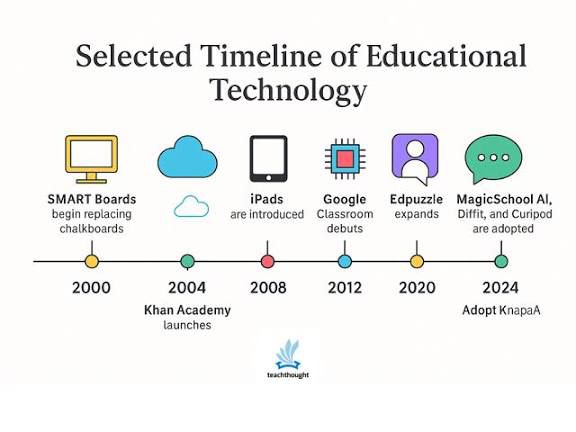
📱 The Connected and Smart Era (2010s-Present)
Characterized by mobility, connectivity, and intelligence.
· Mobile Learning (m-learning): Smartphones and tablets, powered by APK-based apps (as in our previous discussion), made learning truly ubiquitous and on-demand.
· Cloud Computing: Enabled seamless access to tools (like Google Workspace) and resources from any device, fostering collaboration.
· Learning Analytics & AI: The current frontier involves using data to personalize learning paths. Adaptive learning platforms and intelligent tutoring systems that adjust to a student's performance are the heirs to Skinner's teaching machine, now powered by artificial intelligence.
To better understand how these historical tools relate to modern practice, here is a comparison of their key characteristics:
Era / Paradigm Key Technologies Primary Role in Learning Underlying Learning Theory
Pre-Digital & Audiovisual Slate, Film, Radio One-Way Delivery of information; Visual aid. Behaviorism (Stimulus-Response)
Computer-Based Training Teaching Machine, PC Drills Automated Practice & Feedback; Individualized pacing. Behaviorism, Cognitivism
Digital Communication Internet, LMS, Multimedia Access & Communication; Enabling collaboration and resource sharing. Constructivism, Social Learning
Connected & Smart Mobile Apps, Cloud, AI Personalized, Ubiquitous & Adaptive learning experiences. Connectivism, Social Constructivism
This evolution shows that educational technology is not just about the newest gadget; it's a continuous dialogue between technological capability, educational theory, and the societal need for effective learning.
a. Early Stage (Traditional Era)
• Oral teaching and storytelling
• Chalkboard, textbooks, charts
• Teacher-centered instruction
b. Audio-Visual Era (1900s–1950s)
• Use of pictures, radio, film strips
• Educational broadcasting
• Visual aids to support teaching
c. Instructional Technology Era (1960s–1980s)
• Teaching machines
• Programmed instruction
• Systems approach to teaching
d. Computer Era (1980s–1990s)
• Introduction of computers in schools
• Computer-assisted instruction (CAI)
• Educational software
e. Digital and Internet Era (2000s–Present)
• E-learning and online education
• Mobile learning (m-learning)
• Artificial intelligence and virtual classrooms